Home › Anatomy topics › Internal organs
The internal organs, in 3D
Look at the organs where they really sit. 5Anatomy models the brain, lungs, liver, kidneys, gut and more inside the body, and lets you follow a meal, a breath, bile or urine from start to finish.
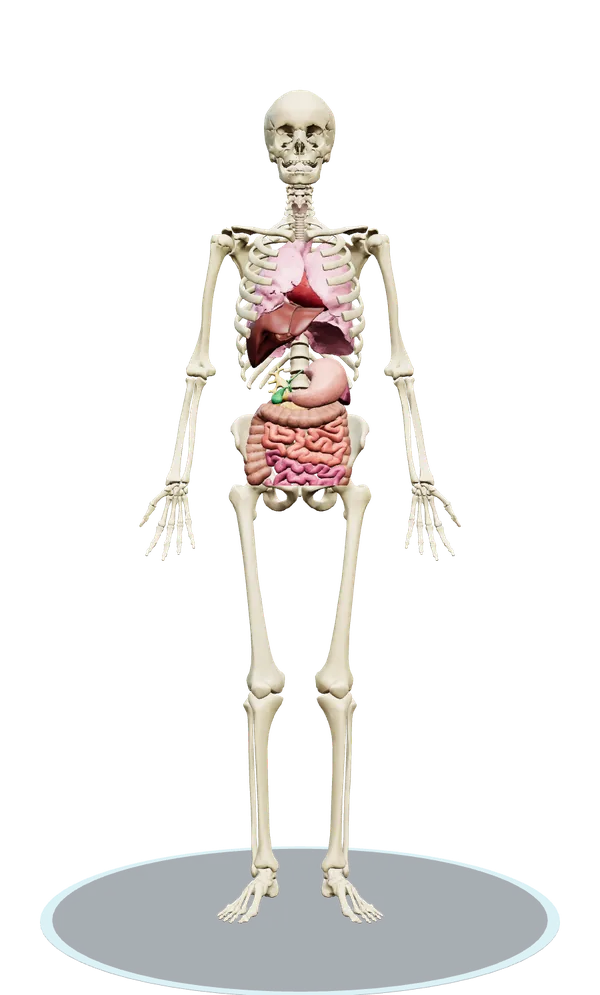
What you can do in the viewer
- Organs in place. See the organs inside the skeleton and behind the skin, in their real positions.
- Select and isolate. Click an organ for its name and notes, and hide the rest.
- Follow a meal (paid plans). From the mouth to the rectum, organ by organ, with a short caption at each step.
- Follow a breath (paid plans). Down the airway to the air sacs and back out again.
- Urine and bile (paid plans). Urine from the kidney to the bladder; bile from the liver to the gut and back by the portal vein.
Where the organs sit
- Thoracic cavity (chest): the heart and lungs, protected by the rib cage.
- Abdominal cavity: the stomach, liver, gallbladder, pancreas and intestines. The kidneys sit at the back of the abdomen, on either side of the spine.
- Pelvic cavity: the bladder and rectum, and in the female body the uterus and ovaries.
- The diaphragm is the dome-shaped muscle that separates the chest from the abdomen and does most of the work of breathing.
- The brain sits inside the skull, and is cushioned by fluid and membranes.
Organs in the viewer
- Brain, with its deeper structures.
- Lungs and airway, including the branching airway tree.
- Heart, in 23 parts (see the circulatory system).
- Liver, gallbladder and pancreas.
- Stomach and intestines.
- Kidneys and adrenal glands.
- Diaphragm, eyes and ears.
Four journeys through the body
- A meal: mouth, oesophagus, stomach, small intestine, large intestine, rectum.
- A breath: nose and airway, down to the air sacs (alveoli) where oxygen enters the blood, and back out.
- Urine: from the kidney through the ureter to the bladder.
- Bile: made in the liver, stored in the gallbladder, released into the gut, and mostly reabsorbed and returned to the liver by the portal vein.
Each journey lights the organs in turn, with a short caption and speed, pause and step controls. These are schematic teaching aids, not patient-specific simulations. The journeys are part of the paid plans.
Frequently asked questions
Which is the largest internal organ?
The liver is the largest internal organ. The skin is the largest organ overall.
What does the diaphragm do?
It is a muscle under the lungs that separates the chest from the abdomen. When it contracts, it flattens and draws air into the lungs.
Can I see the organs without the skin and muscles?
Yes. Turn off the skin and muscle layers and the organs sit inside the skeleton; or isolate one organ with X-ray mode (paid plans).
Can I use it to explain a diagnosis to a patient?
Yes. Doctors use it to show where a problem is. The model is for education and reference only and is not a substitute for professional medical advice.
Keep exploring
See it in 3D
Open the viewer and explore every structure yourself. For education and reference only.
Last updated 23 November 2026