Home › Anatomy topics › Skeletal system
The human skeletal system, in 3D
Rotate the whole skeleton, switch off every other layer, and click any bone to see its name. 5Anatomy models 203 individually named bones on male and female bodies, so you can learn where each one sits and what it touches.
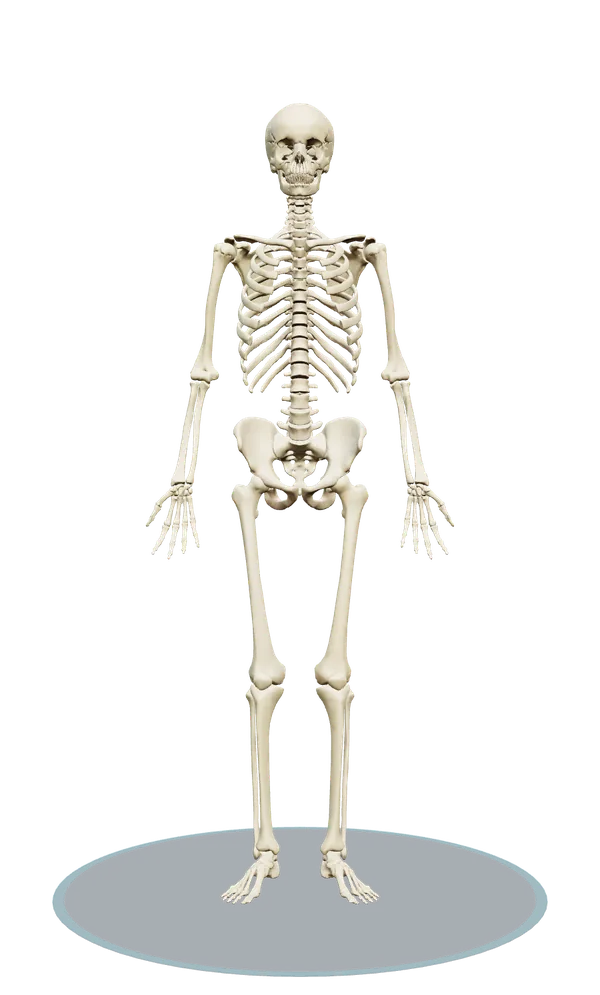
What you can do in the viewer
- Name every bone. Search “femur” or “scapula” and the viewer jumps straight to it.
- Isolate one bone. Fade everything else with X-ray mode (paid plans), or hide the other layers.
- See what attaches where. Switch the muscle layer back on to see which muscles pull on the bone you selected.
- Slice through the body. Section mode cuts on any axis, useful for the spine and the pelvis.
- Compare male and female. Switch between the two skeletons to compare the pelvis, rib cage and skull.
Plans. Every account can use the Skin, Muscles, Skeleton and Organs layers and every named part in them. X-ray and section views, the Vessels layer, the guided journeys, lessons and the certificate need a paid plan. In the first free week you can read the structures list and use the layer switches; switching single structures on and off opens after that. See Pricing.
The skeleton at a glance
An adult skeleton usually has 206 bones. A baby is born with roughly 270, and many of them fuse as the child grows. The skeleton is split into two parts:
- Axial skeleton (about 80 bones): the skull, the vertebral column, the ribs and the sternum. It holds the body upright and protects the brain, spinal cord, heart and lungs.
- Appendicular skeleton (about 126 bones): the shoulder girdle, arms and hands, the pelvic girdle, legs and feet. It gives the body its reach and its movement.
What bones do
- Support: the frame that holds the soft tissues in place.
- Protection: the skull around the brain, the ribs around the heart and lungs, the vertebrae around the spinal cord.
- Movement: bones act as levers that muscles pull on, across joints.
- Storage: bone stores calcium and phosphate, and yellow marrow stores fat.
- Blood cell production: red marrow makes red cells, white cells and platelets.
Regions worth knowing
- Skull: 8 cranial bones around the brain and 14 facial bones.
- Vertebral column: 7 cervical, 12 thoracic and 5 lumbar vertebrae, then the sacrum and the coccyx, which are made of fused vertebrae.
- Rib cage: 12 pairs of ribs. The top 7 pairs join the sternum directly, the next 3 join through cartilage, and the last 2 are “floating”.
- Hand and foot: 27 bones in each hand, 26 in each foot.
- Femur: the thigh bone, the longest and strongest bone in the body.
How to study bones in 3D
A picture in a textbook shows one angle. In 3D you can turn a vertebra until you see its facets, or look at the pelvis from above and below. A method that works well:
- Learn one region at a time: skull, spine, thorax, arm, pelvis, leg.
- Name each bone, then find its neighbours and the joint it forms.
- Switch the muscle layer on and see what attaches to it.
- Hide the labels and test yourself.
Frequently asked questions
How many bones are in the human body?
An adult usually has 206 bones. A newborn has about 270, and some of them fuse during growth. The 5Anatomy model names 203 individual bones.
What is the difference between the axial and the appendicular skeleton?
The axial skeleton is the central axis: skull, spine, ribs and sternum. The appendicular skeleton is the limbs together with the girdles (shoulder and pelvis) that attach them to the axis.
Can I see the skeleton without the muscles and skin?
Yes. The viewer has five layers (skin, muscles, skeleton, organs, vessels) that you switch on and off independently.
Is there a male and a female skeleton?
Yes. Both bodies are in the viewer, and you switch between them with one control.
Keep exploring
See it in 3D
Open the viewer and explore every structure yourself. For education and reference only.
Last updated 20 November 2026